| ECO_CODE | id | COD | ECO_NAME | Glob_Typol |
|---|---|---|---|---|
| REALM: Terrestre (T) | ||||
| Bioma de bosques tropicales y subtropicales (T1) | ||||
| Bosques lluviosos tropicales y subtropicales de tierras bajas (T1.1) | ||||
| T1.1.1 | 00000000000000000000 | D01 | Null Island Tropical Forest | T1.1_NullIsland_forest_D01 |
| Bioma polar/alpino (criogenico) (T6) | ||||
| Pastizales y herbazales de altas montanas tropicales (T6.5) | ||||
| T6.5.1 | 00000000000000000001 | D03 | Null Island Alpine Grassland | T6.5_NullIsland_alpine_D03 |
| REALM: Marina (M) | ||||
| Bioma de plataforma marina (M1) | ||||
| Praderas marinas (M1.1) | ||||
| M1.1.1 | 00000000000000000002 | D02 | Null Island Marine Shelf | M1.1_NullIsland_marine_shelf_D02 |
Terrestrial Ecosystems of Ruritania
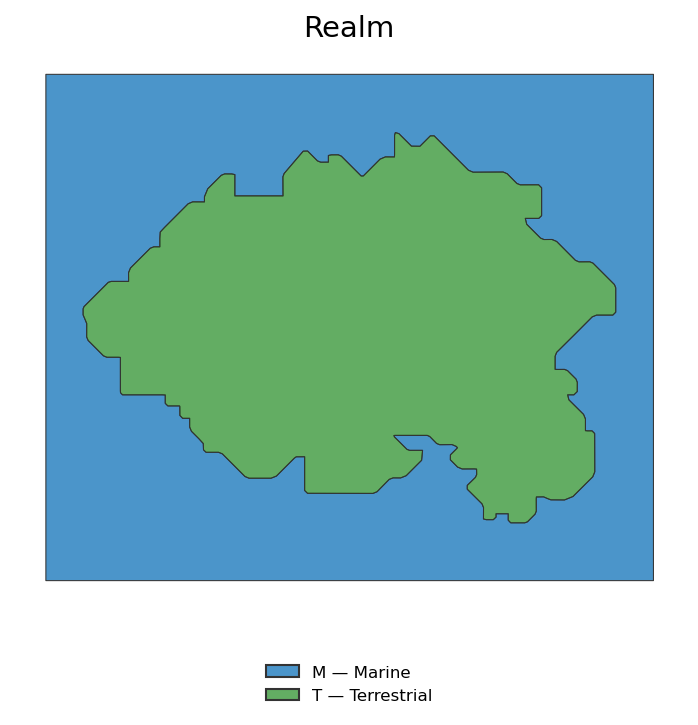
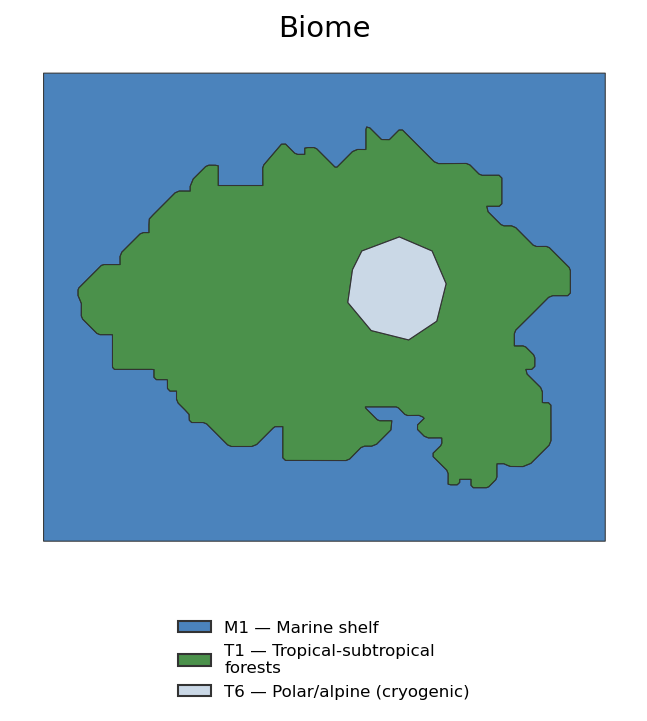
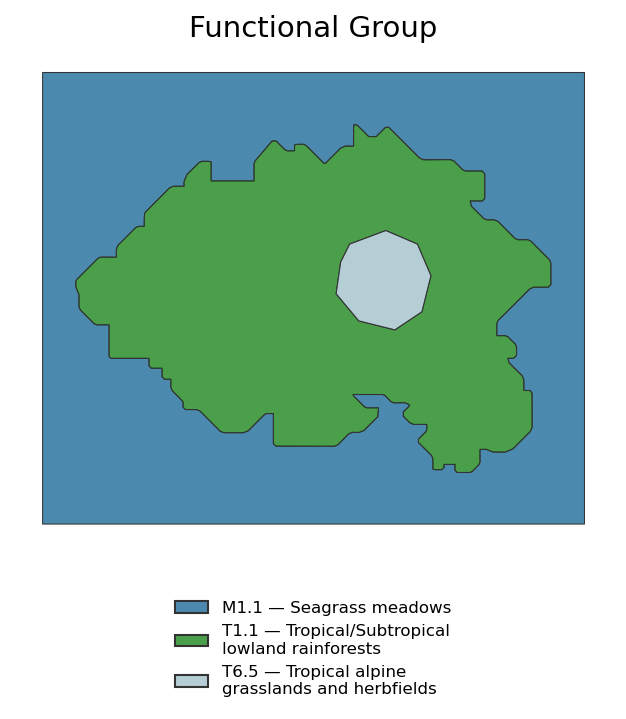
The Ruritania ecosystem typology includes 3 ecosystem types across 3 biomes (Table 2.1). The ecosystem typology is consistent with the IUCN global ecosystem typology (Keith et al. 2020) to support crosswalks and comparisons with Red Lists of ecosystems in other countries and regions. The Ruritania ecosystem typology has a hierarchical structure, where each ecosystem type is assigned to a realm, biome and functional group (ecotype). Realm refers to one of the four component media in the biosphere (Figure 2.1), biome is the segment of the biosphere united by major functional traits and macro-environmental features (Figure 2.2), and functional group is a group of related ecosystems within a biome (Figure 2.3). The distribution of Ruritania’s ecosystem types is shown in Figure 2.4, and map data is made publicly available (reference?).
(Heat map of the distribution of natural ecosystem types not implemented yet.)
ImportantHow to customize the Ecosystem Overview page
- To modify the ecosystem overview text, edit the
content/2_ecosystem_overview.qmdfile. - To remove the ecosystem overview section, edit the
_quarto.ymlfile and remove the- content/2_ecosystem_overview.qmdline.
To hide these instructions on all pages, set show-instructions: false in the _quarto.yml file.